
Indoor cats spend all their time within four walls, yet their minds are always working. Even in a safe, comfortable environment, a cat’s brain craves opportunities to explore, solve problems, and make choices. Boredom isn’t just about feeling “unstimulated.” It can actually lead to unwanted behaviors and even affect a cat’s overall well-being.
Everyday indoor life can lack the hunting, searching, and investigating that cats would naturally do in the wild. That’s why I believe cat owners should look for ways to let their indoor cats investigate, problem solve, search for food, move objects with their paws and mouth, use their senses, and earn rewards. Offering puzzles and challenges is one of the best ways to provide real enrichment.
This article focuses on puzzles and challenges for indoor cats. It isn’t just about finding another busy activity. The real value comes from giving your cat something to figure out, which brings real satisfaction and helps sharpen their natural instincts.
🐾 Purr-lease Note: FelineGo is an Amazon Associate, which means we may earn a small commission from qualifying purchases made through some of the Amazon links on this site. This comes at no extra cost to you and helps support FelineGo and our mission to create helpful content for cat parents. Thank you for supporting our little corner of the cat world! 🐱💕
#ad
Recommended Products To Recreate This Look:
Why Puzzles and Challenges Are Good for Indoor Cats
Bringing in puzzles and challenges for your indoor cat does a lot more than simply pass the time. Offering different puzzles for cats gives them structured and enjoyable ways to use their brains, which can have positive effects on both behavior and quality of life.
They Encourage Natural Problem Solving
Many puzzles for cats tap into their instinct to explore, search, and work toward a goal. When solving a simple treat puzzle, the cat gets to use mental skills that would come naturally in the wild: sniffing, investigating, pawing, and working through obstacles. These puzzle solving moments are not just about getting a treat, but about feeling in control and capable of handling something on their own.
They Add Variety to Indoor Life
Indoor cats often face the same sights and routines each day. Adding cat puzzle games switches things up and brings new excitement into the environment. I’ve seen how rotating different puzzles or creating new DIY cat enrichment activities can prevent boredom and keep my cat’s interest going over time.
They Can Make Mealtimes More Engaging
Feeding from a regular bowl is quick and straightforward, but it misses the chance for feeding to become an engaging activity. Food puzzles for cats can slow down eating and make every meal feel like a hunting mission. Not only does this stretch out their mealtime in a fun way, but it can also help prevent issues like overeating or gulping food.
They Give Cats Choices and Control
Offering a mix of cat enrichment activities means your cat gets to decide which games catch their interest at any given moment. Sometimes a cat ignores a puzzle for hours, then suddenly solves it on their own terms. The option to choose adds a sense of control and personal agency that really helps feline happiness.
15 Puzzles and Challenges for Indoor Cats
1. Treat Searching Puzzle
You can hide a few treats in easy-to-reach places that your cat can access, such as on a scratching post or behind a toy. At first, start with very easy hiding spots, then make things trickier by putting treats under or inside objects. This encourages active searching, which is great for indoor cat enrichment and keeps them alert.
2. DIY Toilet Paper Roll Puzzle
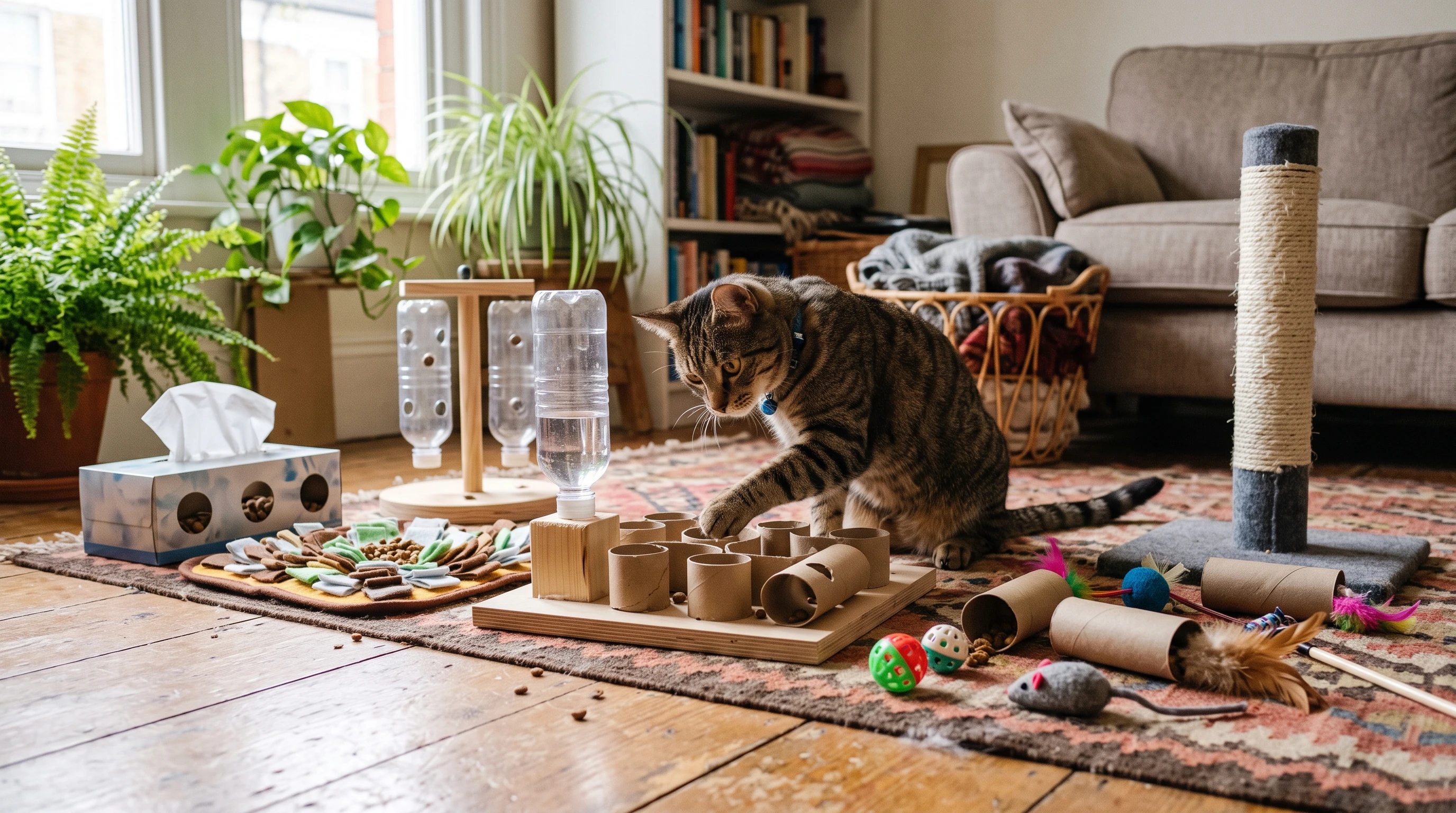
Using empty cardboard tubes, create little compartments and tuck treats or kibble inside. At first, you can choose to fold one end of the tube so treats don’t fall out too easily. Next, you can increase the challenge by bunching several tubes together or even partially sealing both ends, so the cat has to paw and move things around to get the reward.
3. Muffin Tin Food Puzzle
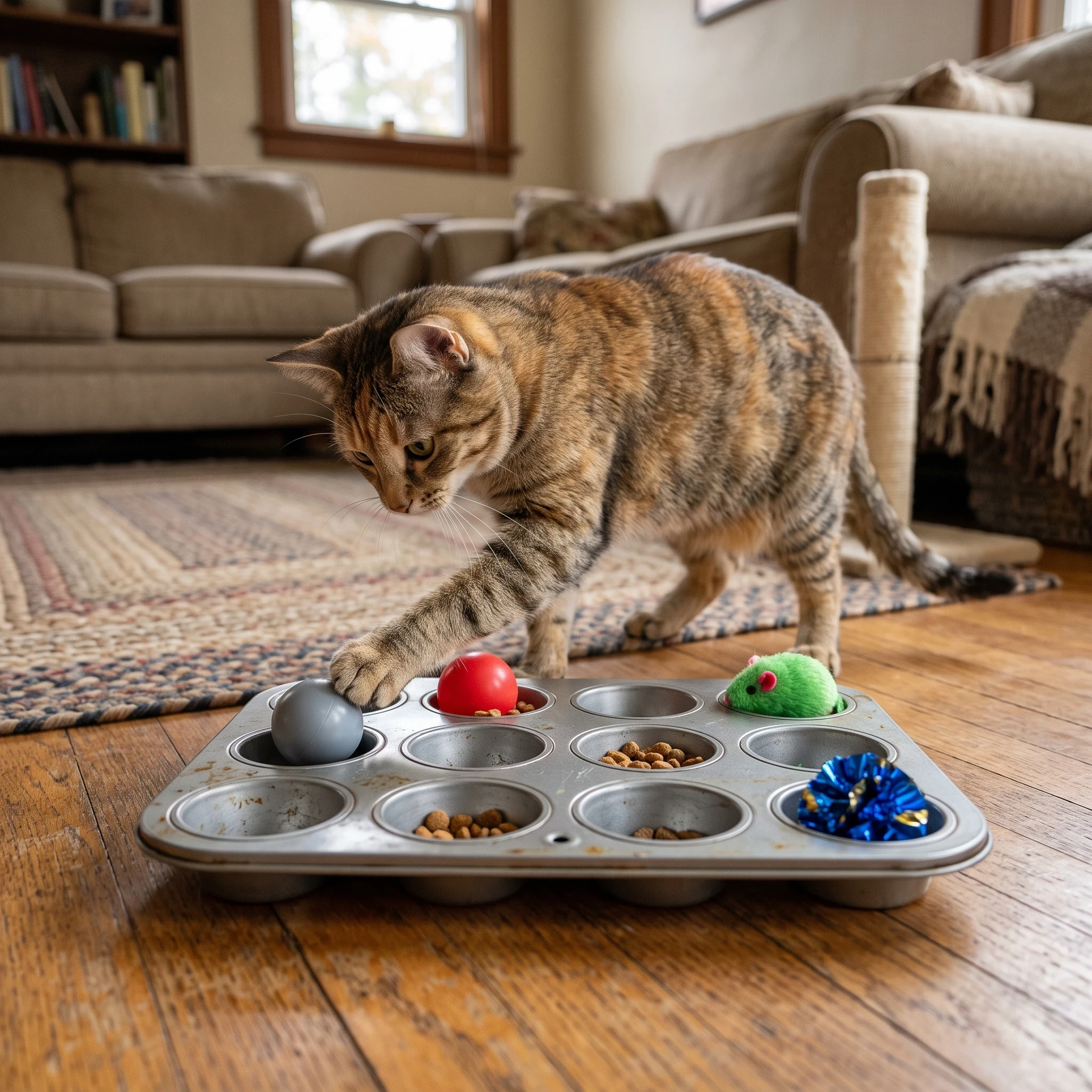
Take a regular muffin tin and put a few pieces of kibble in several cups. Then, put lightweight balls or toys over some compartments to make the cat move them aside to get the food. This is a simple introduction to food puzzles for cats and really easy to set up.
4. Cardboard Box Puzzle
Creating small holes or flaps in a sturdy cardboard box gives you a place to hide treats or toys. Watch as your cat sniffs, paws, and works out how to get the reward from the compartments. This setup is very different from just jumping in a box, because now the box has become a brain game.
5. DIY Treat Puzzle With Paper Cups
Set out three or four paper cups and place treats under two or three cups. In the beginning, leave the cups tipped so the reward is obvious. Another variation will be to postion the cups upright. Most cats learns quickly to push,tip over the cup, or reach inside upright cups to get what’s inside.
6. The “Which Cup?” Game
This is a variation of the previous game. Line up several small cups and hide a treat under just one, instead of several cups. At first, use only two or three cups and let the cat use their nose and paws to figure out the right one. Over time, add more cups for an extra mental workout.
7. Sniff and Find Challenge
Split your cat’s daily dry food into small amounts and hide them around safe areas of the home. Choose hiding spots that encourage gentle searching, such as on a windowsill or under the edge of a play mat. Foraging for food isn’t just mental stimulation for cats; it mimics what they’d do in the wild. You can use foraging toys, either DIY or bought from a store, hidden around the house for this activity.
8. Puzzle Feeder Challenge
Feeding from a puzzle feeder is one of the most effective ways to provide cat brain games regularly. Simple puzzle feeders dispense food with minimal effort, while more advanced versions might require the cat to slide, twist, or remove parts to unlock food. I like to suggest starting with easy versions, then gradually use more challenging feeders as the cat learns.
9. The Open and Find Challenge
You can set up a tissue box with the opening cut larger and place a treat or small toy inside. The cat has to reach in and pull the object out, which is a solid tactile challenge. Please always use safe, sturdy boxes and watch for signs of frustration.
10. Cardboard Maze Challenge
A simple maze can be made by connecting several cardboard boxes. Then, place a treat or favorite toy at the end for the cat to “hunt.” This form of DIY cat enrichment helps build problem solving skills.
11. Toy Retrieval Challenge
For this activity, you can wedge a wand toy under the edge of a soft rug or behind an obstacle so that the cat has to plan how to retrieve it. It’s very important to make sure there aren’t any gaps that could trap a paw. This challenge builds patience and creativity.
12. Choose-the-Toy Challenge
Offering a selection of toys with different textures, sounds, and shapes allows the cat to choose based on mood. Scatter a few plush toys, a crinkle ball, and a feather at once, then watch which one gets their attention. Giving choices is a key part of successful cat enrichment activities.
13. Multi-Step Treasure Hunt
Instead of placing one treat in one place, you can set up a series of clues, such as their favorite toys leading to another area or a trail of kibble. In the beginning, two steps is enough—find a toy, then find the reward in another spot. Over time, add more steps so the hunt feels more like a real adventure. Think of this as like a treat hunt, but with some “clues” leading to the cat discovering where the treat is hidden. It’s fine even if they end up not finding the treat themselves, if they enjoyed playing with the toys or eating the trail of kibbles!
14. Training Challenge
Positive reinforcement isn’t only for dogs. You can also teach a cat simple cues such as “touch” (tap a hand), “sit,” or “come.” The reward is a treat or play time. These training sessions are short, upbeat, and focus on fun, not obedience. They work well as boredom busters for cats who love attention.
15. Create Your Own Cat Puzzle Challenge
Many of the activities listed here can be incorporated together to create a whole new activity; a cardboard box maze with tubes, treats, and toys all mixed together. Mixing up materials gives anyone unlimited options for game design. As with any puzzle, always watch how the cat interacts and adjust as needed to keep things fun, not frustrating.
How to Make Cat Puzzles More Challenging
One thing I noticed quickly is that some cats find easy puzzles just too simple. If you find your own cat solve a muffin tin game in seconds, that may mean you have to come up with more variations. Gradually increasing difficulty is much better than jumping to the hardest challenge right away.
- Level 1. Easy: Treat is visible immediately, and the cat only has to reach for it.
- Level 2. Simple Problem: The cat needs to move or tip something (like a cup or ball) to get the treat.
- Level 3. Search: The treat or toy is hidden or covered, and finding it requires sniffing or exploring.
- Level 4. Multiple Steps: The cat must perform two or more actions, for example, finding a toy or following a trail of kibbles, then using that as a “clue” to discover the treat or reward.
- Level 5. Variable Challenge: Puzzle locations, toys, or hiding spots are changed frequently so the cat can’t rely on one memory or routine.
The goal is to keep your cat mentally stimulated without causing frustration. Keep an eye on your cat for signs of boredom or stress and drop back a level if something isn’t working. Flexibility is super important, and keeping puzzles fresh helps maintain interest for the long term.
Choosing the Right Puzzle for Your Cat
Each cat has their own personality, preferences, and comfort level with new activities. Some get into things right away, while others need time to warm up. When introducing new cat puzzles or brain games, stick to a few basic ideas:
- Start Simple: Jumping into complex puzzles too quickly may lead to frustration. Use basic versions at first, then add new elements if your cat seems ready.
- Safety First: Please only use non-toxic, cat-safe materials. Any small parts that could be swallowed are kept out of reach. Cardboard, paper, and sturdy plastic generally work best.
- Monitor Play: Especially the first time with a new puzzle, watch to make sure the cat isn’t overly stressed or at risk of being trapped.
- Don’t Force It: Not every cat likes every puzzle, and that’s okay. I let my cat check out new games in their own time.
- Regular Rotation: Swapping out toys and puzzles every week or two keeps everything fresh and discourages boredom.
#ad
Make It Yourself!
Frequently Asked Questions (FAQs) About Cat Puzzles and Enrichment
Question: What are good puzzles for cats who aren’t interested in food?
Answer: While many cats love food-based puzzles, some prefer toys with movement or different textures. Ball tracks, crinkle tunnels, and feather toys that can be chased and caught offer mental and physical stimulation without relying on treats.
Question: How do I know if a puzzle is too hard or too easy?
Answer: If your cat loses interest quickly, the puzzle may be too simple or too hard. Look for signs of excitement and engagement, like sniffing, pawing, or returning to the activity after a break, which mean the puzzle is just right.
Question: Can puzzles replace regular playtime?
Answer: Puzzles are a great supplement but shouldn’t take the place of daily interactive play. Both activities help out with indoor cat enrichment in different ways. Alternate between active play, such as with wand toys, and puzzles for a well rounded routine.
Question: Is it safe to leave my cat alone with puzzles?
Answer: For anything with small parts or unfamiliar materials, I recommend supervising at first. Once you know the puzzle is safe, you can leave it out for solo exploring, but always check for wear and tear.
Every indoor cat’s happiness and health benefit from regular mental workouts. Using puzzles and challenges keeps minds sharp, mealtimes exciting, and daily routines more fun. I’ve seen my cat’s confidence and mood improve with every new enrichment game. Starting simple and getting creative with materials you already have at home can turn any ordinary day into a rewarding adventure for your indoor cat.