Cats that eat too quickly can sometimes develop problems such as regurgitation or vomiting, and fast eating can make it harder to manage food intake. [1] I know from my experience with my own fast-eater that having the right slow feeder can make daily meals safer and more enjoyable for both you and your cat.
🐾 Purr-lease Note: As an Amazon Associate I earn from qualifying purchases. This means FelineGo may earn a small commission when you purchase through some of the Amazon links on this site, at no extra cost to you. These commissions help support FelineGo and our mission to create helpful content for cat parents. Thank you for supporting our little corner of the cat world! 🐱💕
What Is a Slow Feeder for Cats?
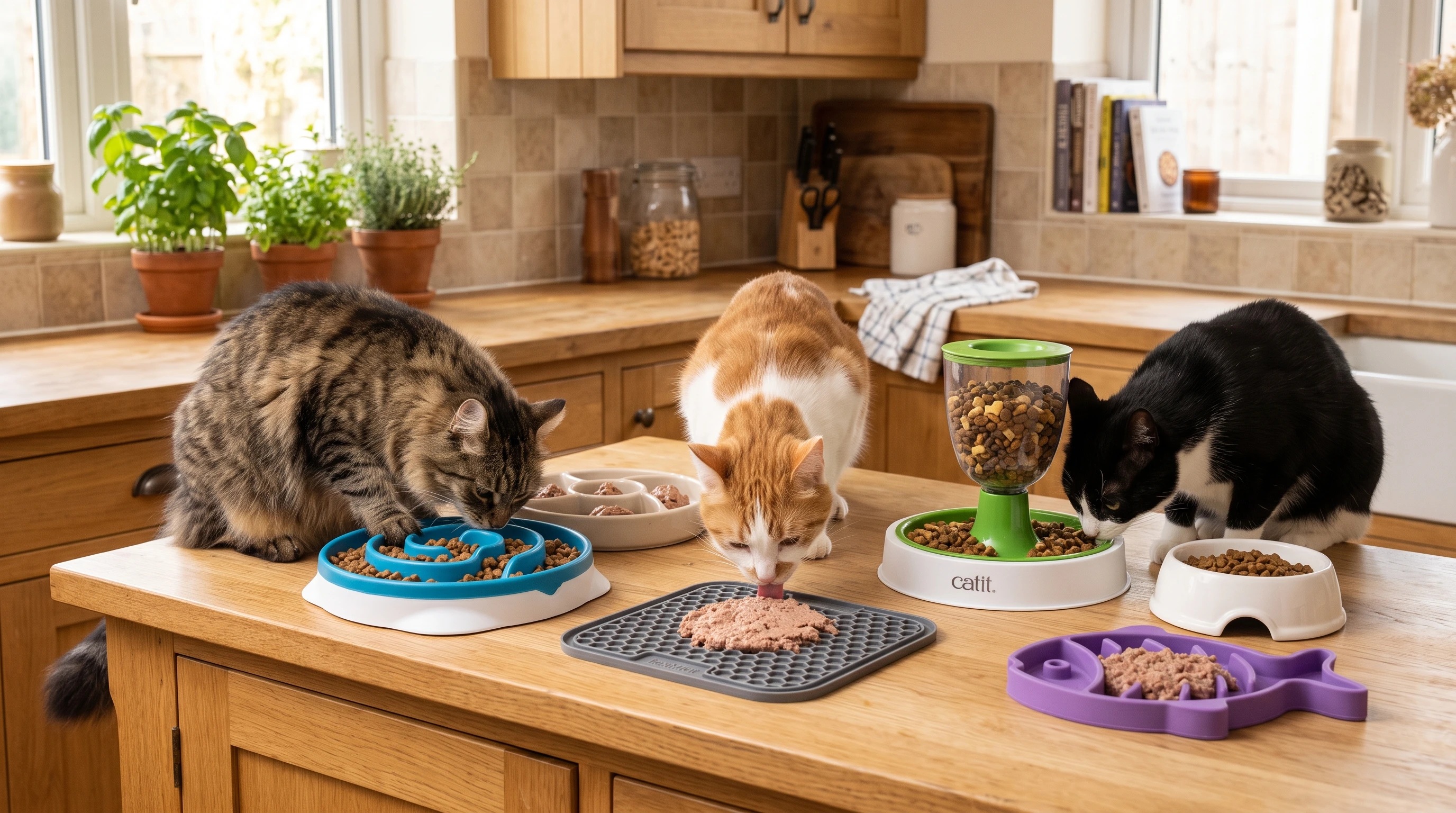
A slow feeder is any bowl, mat, or puzzle that is made to help cats eat their food at a slower pace. These feeders use physical obstacles, such as ridges, nubs, mazes, or compartments, to break up the food and stop your cat from simply gulping everything down in one go. Use slow feeders with your cat to slow them down during mealtime, while also turning it into a fun and more natural foraging activity. [2][3]
How Do Slow Feeders Help Cats Eat More Slowly?
Slow feeders slow down eating by making your cat work for each piece or lick. Instead of quickly inhaling a pile of kibble, your cat must pick up food from in between ridges or solve small puzzles to get their meal. [2][3] This slower pace can help prevent cats from gulping their food and may help reduce problems such as regurgitation associated with eating too quickly. [1][3] Interactive feeders can help cats that eat too aggressively by slowing the pace of eating, which may reduce problems such as regurgitation or vomiting.
Best Slow Feeders for Cats
Catit Play Cat Treat Puzzle #ad
It offers a bunch of different challenges in one feeder, including treat tubes, pyramid forest, treat cave, cat slow feeder bubbles, cat food spiral, and cat tunnels, turning meals into a fun, interactive experience. A food-motivated cat who loves variety may enjoy this, and it works well for dry food and treats. The parts are easy to disassemble and clean by handwashing. It is designed for regular use.
TRIXIE Fun Board #ad
The TRIXIE Fun Board comes with five different activity zones, which tap into your cat’s natural hunting instincts. Watch as your cat enjoys solving the various compartments and difficulty levels, pawing dry kibble out of small wells. It’s especially good for clever, high-energy cats who need some extra mental stimulation alongside their meals.
Catstages Nina Ottosson Buggin’ Out Puzzle & Play Cat Toy #ad
This puzzle feeder features 16 hidden treat compartments and has an adjustable Level 2 difficulty, which allows you to make it easier for beginners or more challenging as your cat improves. Cats have to move elements around with their nose or paw to access the food, which slows the process. I find it great for keeping clever cats busy and for managing their meal portions.
Catstages Nina Ottosson Rainy Day Puzzle & Play Cat Toy #ad
This one is a level up in challenge, with 19 treat compartments in total: 14 base compartments plus 5 compartments in the movable pegs. This puzzle includes sliding, swiveling, and spinning mechanisms, offering extra challenge compared to the previous puzzle. If you have a cat that needs extra entertainment and tends to eat very quickly, this puzzle-style feeder helps break up mealtime while keeping your cat focused and engaged.
Catstages Kitty Slow Feeder Bowl #ad
If you just want a simple, affordable slow feeder that works for both wet food and dry kibble, this one is a good choice. It’s lightweight and has raised ridges that most cats can easily navigate, although some flat-faced cats may find this design more difficult to use because of their facial structure. Cleaning is quick, and the design fits smaller spaces. It is also top-rack dishwasher-safe.
Neater Feeder Express #ad
This is a raised feeder with a roomy, spill-proof design and two whisker-friendly stainless steel cat bowls, making it a nice pick especially for multi-cat homes or if you want everything in one tidy station. While not a slow feeder by default, it works really well to keep your area by helping keep messy eaters from scattering food everywhere. The feeder’s elevated design and spill-containment features may make mealtimes more convenient, but it should not be presented as a treatment for regurgitation.
How to Choose a Slow Feeder for Your Cat
#ad | Affiliate links below.
Food type
Some slow feeders work great for dry kibble, while others are designed for wet foods or mixed diets. For example, the Catstages Kitty Slow Feeder Bowl handles dry food pretty well (although their product page specifies it can also hold wet food), while LickiMat Casper, LickiMat Tuff, and LickiMat Slomo are perfect for wet or spreadable foods. If you feed both types, you might want more than one slow feeder.
Bowl depth and whisker clearance
Some cats may prefer wider or shallower feeding surfaces if their whiskers repeatedly contact the sides of a bowl. [4][7] Look for feeders that have a wider or shallower design if your cat refuses to eat from standard bowls or seems fussy around mealtime. [7] Flat-faced cats may find low, broad feeding surfaces easier to access, although individual preferences vary.
Difficulty
Some cats enjoy complex puzzles, but others may get frustrated and give up. If your cat is new to slow feeders, start with something simple like the Catstages Kitty Slow Feeder, then try puzzles like the Rainy Day Play Toy as they get more used to the challenge.
Material
Look for food-safe materials such as ceramic, stainless steel, or BPA-free plastic. Silicone or rubber feeding mats such as the Coomazy Slow Feeder Cat Bowl Silicone and LickiMat options can be convenient for serving wet or spreadable foods.
Stability
Unstable bowls can be more trouble than they’re worth. Choose feeders with a nonslip bottom or enough weight to prevent your cat from flipping the bowl. Elevated feeders like the Neater Feeder Express stay put even with vigorous eaters.
Cleaning
Since cat food can get crusty, especially with wet feeding, pick slow feeders that are dishwasher safe or fast to wash by hand. Products like the LickiMat Tuff [6], Catstages Kitty Slow Feeder, and Coomazy Bowl can all be tossed in the dishwasher for top-rack cleaning, although you should always check the manufacturer’s instructions for the specific model.
Size/capacity
Make sure the slow feeder you choose holds enough food for your cat’s usual portion size. Too little space might frustrate your cat and cause them to give up quickly, while too large a feeder takes up extra space unnecessarily.
Best Slow Feeders for Different Cats
#ad | Affiliate links below.
Flat-faced cats
Flat-faced, or brachycephalic, cats may have more difficulty accessing some slow feeders because of their facial structure. [7] The Neater Feeder Express, LickiMat Casper, and PTOBER Ceramic Slow Feeder Cat Bowl have relatively open or shallow feeding surfaces that may be easier for some flat-faced cats to access.
Cats with whisker sensitivity
Cats who avoid deep or high-sided dishes may prefer slow feeders with more open access. [4][7] LickiMat Slomo and Casper provide relatively open, low-profile feeding surfaces that may be useful for cats that dislike conventional bowls. [4]
Kittens
Kittens can start with feeders that have lower ridges and easy puzzles. Catstages Kitty Slow Feeder Bowl or a soft silicone mat is a gentle way to slow down enthusiastic eaters without causing frustration.
Senior cats
Older cats may have dental sensitivities or mobility issues, so feeding equipment should be chosen according to the individual cat’s abilities and preferences. [5] Soft mats like LickiMat Casper may be easier for some cats to use, while puzzle feeders should be kept appropriately simple.
Multi-cat households
If you have more than one cat, individual feeding stations can give each cat their own space and may help reduce competition around food. [5] Multiple Catstages Kitty Slow Feeder Bowls or silicone mats work really well; each cat gets their own spot and pace.
Learn more on how to set up cat food stations in multi-cat homes: How To Set Up A Cat Food Station
Best Elevated Slow Feeder
#ad | Affiliate links below.
Elevated feeding bowls can make food more accessible for some cats, but there is limited evidence that elevated bowls generally reduce neck strain in healthy cats. [5] The Neater Feeder Express is my pick for a neat and spill-resistant option. For an actual slow-feeding design, the TRUNDISAN Ceramic Elevated Slow Feeder features a raised ceramic bowl with protrusions that create obstacles around which cats eat. The Y YHY Ceramic Cat Slow Feeder combines an elevated, tilted design with raised features intended to slow eating.
Best Dishwasher Safe Option
#ad | Affiliate links below.
Dishwasher-safe slow feeders save so much time. LickiMat Tuff is sturdy and can be washed according to the manufacturer’s instructions. [6] Catstages Kitty Slow Feeder and Coomazy Slow Feeder Cat Bowl Silicone are also easy to toss into the dishwasher and come out clean for next use.
Best Puzzle-Style Feeder
#ad | Affiliate links below.
For cats who need more than just physical obstacles, puzzle slow feeders are a great way to challenge their brains while helping them eat slowly. The TRIXIE Fun Board stands out with its mix of puzzles, from cups to small nooks. Catstages Nina Ottosson Buggin’ Out and Rainy Day Puzzle & Play cat toys offer hidden treat compartments with moving pieces that keep even the smartest cats busy. The Catit Play Cat Treat Puzzle includes spirals, tubes, caves, and other puzzle elements that encourage foraging behavior. [2][3]
Can a Slow Feeder Help a Cat Lose Weight?
Slow feeders can help control the pace of eating and provide enrichment, but they should not be relied upon as a weight-loss method. [1][2][3][8] Portion control and management of total daily calorie intake remain important for maintaining a healthy body weight. [1][8] While a slow feeder alone won’t cause weight loss, pairing appropriate portions with regular activity and enrichment can support a healthy weight-management plan. [2][8]
Read more: How To Help Overweight Cats Exercise
Indoor Games For Overweight Cats
How to Introduce a Slow Feeder
#ad | Affiliate links below.
Some cats do not take routine changes lightly, even if it’s good for them. Some people may find it easier to start by sprinkling treats or a small handful of kibble into the slow feeder alongside their regular bowl, letting the cat explore the new feeder without pressure. [2][3] Once they’re comfortable, you can then gradually move more of the meal into the slow feeder over several days. For some cats or those who are new to puzzles, beginning with a simple feeder like the Catstages Kitty Slow Feeder helps keep the transition smooth. [2][3]
How to Clean and When to Replace a Slow Feeder
Staying on top of cleaning prevents bacteria buildup, especially with wet food or if you notice food residue. I suggest cleaning slow feeders after every use and following the manufacturer’s instructions when doing so. If the feeder gets scratched up, loses parts, or starts to get sticky or gross even after washing, it’s a good idea to replace it. New feeders are also a fun way to reset interest if your cat gets bored.
Choosing a Slow Feeder for Your Cat
#ad | Affiliate links below.
To sum up, I find that picking a slow feeder depends on your cat’s personality and their eating style. LickiMat Casper works well for wet food fans and licking enrichment. [6] Catstages Kitty Slow Feeder is a great basic option for kibble. Catit Play Cat Treat Puzzle ramps up the challenge, and TRIXIE Cat Activity Fun Board offers a variety of activities for curious or playful cats.
Slow Feeder vs. Puzzle Feeder
#ad | Affiliate links below.
Traditional slow feeders, like the Catstages Kitty Slow Feeder, use ridges or bump patterns to separate the kibble and slow down eating. LickiMat Casper encourages licking and spreading meals out, making it great for wet food and enrichment. [2][3][6] Catit Play Cat Treat Puzzle and TRIXIE Cat Activity Fun Board fall into the puzzle feeder category, requiring cats to bat, slide, or paw at food, making meals more challenging and entertaining. [2][3] You may choose to rotate between all three styles based on your cat’s mood and food type, keeping mealtime engaging and stress-free.
FAQs
#ad | Affiliate links below.
Can I use a slow feeder for wet food?
Yes, wet food works with certain slow feeders. LickiMat Casper, LickiMat Tuff, Catstages Kitty Slow Feeder, and LickiMat Slomo are all good choices. Smooth mats or shallow ceramic feeders are best for wet meals.
Why is my cat still eating fast with a slow feeder?
If your cat has figured out an easy slow feeder, you might want to try something more challenging like a LickiMat, Nina Ottosson puzzle, or TRIXIE Fun Board, provided your cat is comfortable using the feeder and can access the food without becoming frustrated. [2][3] You can also separate meals into smaller amounts and spread them out in the feeder. [1][3]
How do I introduce a slow feeder?
Starting with a simple design, like the Catstages Kitty Slow Feeder, helps cats get used to new routines before moving on to complicated puzzle feeders. [2][3] Go slow, use treats, and be patient.
Best slow feeder for small homes/apartments?
LickiMat Casper and Catstages Kitty Slow Feeder are both compact and fit easily in tight spaces, plus they’re lightweight and easy to store.
Best for multicat households?
Using multiple individual feeding stations, like several Catstages Kitty Slow Feeder Bowls, can give each cat their own space and may help reduce competition around food. [5] Silicone mats also stack and wash easily.
References
- VCA Animal Hospitals. Feeding a Cat Who Loves to Eat. https://vcahospitals.com/lakeline/know-your-pet/feline-gluttons
- VCA Animal Hospitals. Interactive Toys Make Your Pet’s Mealtime Fun and Engaging. https://vcahospitals.com/resources/preventive-cat/nutrition/interactive-toys-make-your-pets-mealtime-fun-and-engaging
- VCA Animal Hospitals. Feeding the Mind and Body: Interactive Feeders for Dogs and Cats. https://vcahospitals.com/lakeline/know-your-pet/feeding-the-mind-and-body-interactive-feeders-for-dogs-and-cats
- Slovak JE, Foster TE. Evaluation of whisker stress in cats. J Feline Med Surg. 2021 Apr;23(4):389-392. doi: 10.1177/1098612X20930190. Epub 2020 Jun 15. PMID: 32538246; PMCID: PMC10812207. View source
- World Small Animal Veterinary Association (WSAVA). Global Nutrition Guidelines. https://wsava.org/global-guidelines/global-nutrition-guidelines/
- LickiMat. Frequently Asked Questions. https://lickimat.com/pages/faqs
- International Cat Care. Managing the Cat That Won’t Eat. https://icatcare.org/resources/cat-carer-guide-managing-the-cat-that-wont-eat.pdf
- VCA Animal Hospitals. Creating a Weight Reduction Plan for Cats. https://vcahospitals.com/know-your-pet/creating-a-weight-reduction-plan-for-cats