
Your cat has probably been in pain at some point and you never knew. Cats are famously hard to read when they hurt, and veterinary researchers have been saying so for years. The good news is that those same researchers have built tools for spotting pain in cats, and you can borrow most of them at home with no equipment and no degree.
This article walks through what the research looks at and turns each piece into something you can check tonight. It also covers when to stop watching and call the vet. Sources are numbered in brackets and listed at the end, so you can check them yourself.
🐾 Purr-lease Note: As an Amazon Associate I earn from qualifying purchases. This means FelineGo may earn a small commission when you purchase through some of the Amazon links on this site, at no extra cost to you. These commissions help support FelineGo and our mission to create helpful content for cat parents. Thank you for supporting our little corner of the cat world! 🐱💕
Why your cat is a world-class poker player about pain
Cats are predators, but they are also small enough to be prey for larger animals. A common explanation for their stoicism is that visible weakness is risky, so a hurting cat often tries to look fine. Whatever the full evolutionary story, the practical result is well documented: pain in cats, especially long-term pain, is easy to miss and has been described as an under-recognised welfare problem [5].
Dogs often yelp, limp and beg for sympathy. Cats tend to go quiet, sleep somewhere new, or simply do a little less than they used to. That is why pain researchers lean so heavily on small, specific observations instead of waiting for an obvious cry.
What the researchers look at: faces, posture and behavior
Studies of feline pain tend to rely on three kinds of evidence:
- Facial expression. Pain changes how a cat’s face is arranged, and scales exist to score those changes [1].
- Posture and movement. How a cat sits, walks, jumps and settles can show discomfort that never turns into a cry.
- Behavior change. A systematic review of behavior-based pain assessment in cats found that researchers watch for shifts in everyday activity, interaction and routine, not just dramatic signs [2].
Each of these can be checked at home. None of them replaces an exam, but together they give you a much better picture than “he seems okay.”
The Feline Grimace Scale: reading your cat’s face (without a degree)
The Feline Grimace Scale was developed and tested by researchers who studied cats’ faces during and after painful episodes, then checked whether trained scorers could use the scale reliably [1]. It looks at five features, called action units, and each is scored from 0 (relaxed) to 2 (clearly changed):
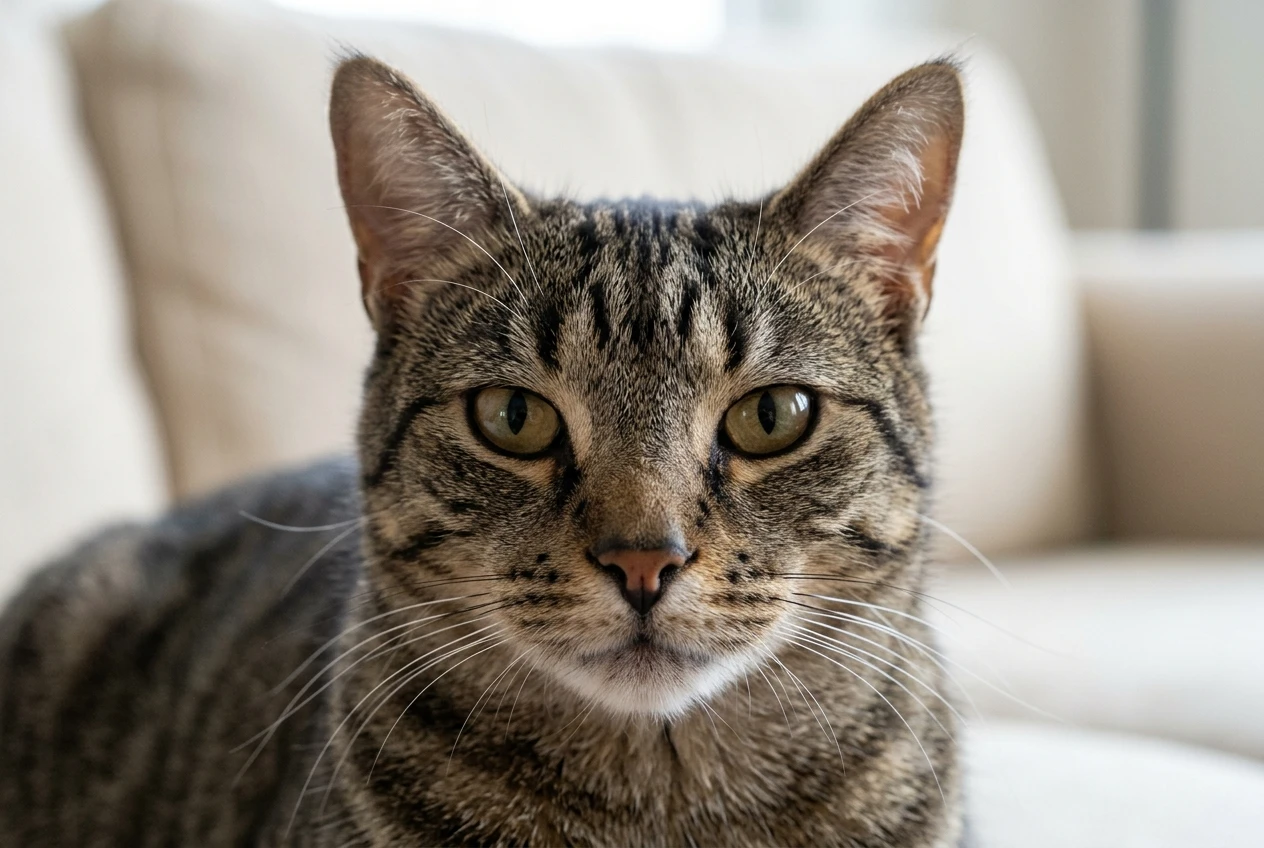
- Ear position. Ears that flatten or rotate outward and apart, instead of facing forward.
- Orbital tightening. Eyes that narrow or squint.
- Muzzle tension. A muzzle that looks tight and more oval than the usual relaxed, rounded shape.
- Whisker position. Whiskers that move away from the face and look straighter and more forward than usual.
- Head position. A head held low, below the line of the shoulders, instead of up and alert.
The scale was built around cats in acute pain, such as after surgery, so treat it as a prompt for a closer look and not a diagnosis [1]. A squint can also come from bright light, sleepiness or an eye problem.
The most useful home trick is a baseline. Take a few photos of your cat on a good day, awake and relaxed, from the front and the side. Later, if something feels off, you have a comparison for what “normal ears” and “normal eyes” look like on this particular cat. Faces vary from cat to cat, and your own photos beat any chart.
The quiet changes owners tend to write off as “just getting older”
This is where the research gets uncomfortable. Many of the changes owners attribute to age are also what pain looks like, particularly joint pain.
Degenerative joint disease is common in cats. A radiographic study of domestic cats found that a majority had signs of it in at least one joint, and the proportion rose with age [4]. Another paper on feline osteoarthritis examined how often it occurs and how easy it is to recognise, and the recognition part is the problem: cats rarely limp in a way owners notice [6].
Owner-reported tools help here. The Feline Musculoskeletal Pain Index is a questionnaire in which owners rate how well their cat manages everyday activities such as jumping up, jumping down, running and playing, and it was tested for its ability to tell cats with joint disease from those without [3]. In other words, research supports asking owners what their cat can still do.
Here are the changes to watch for, framed as questions:
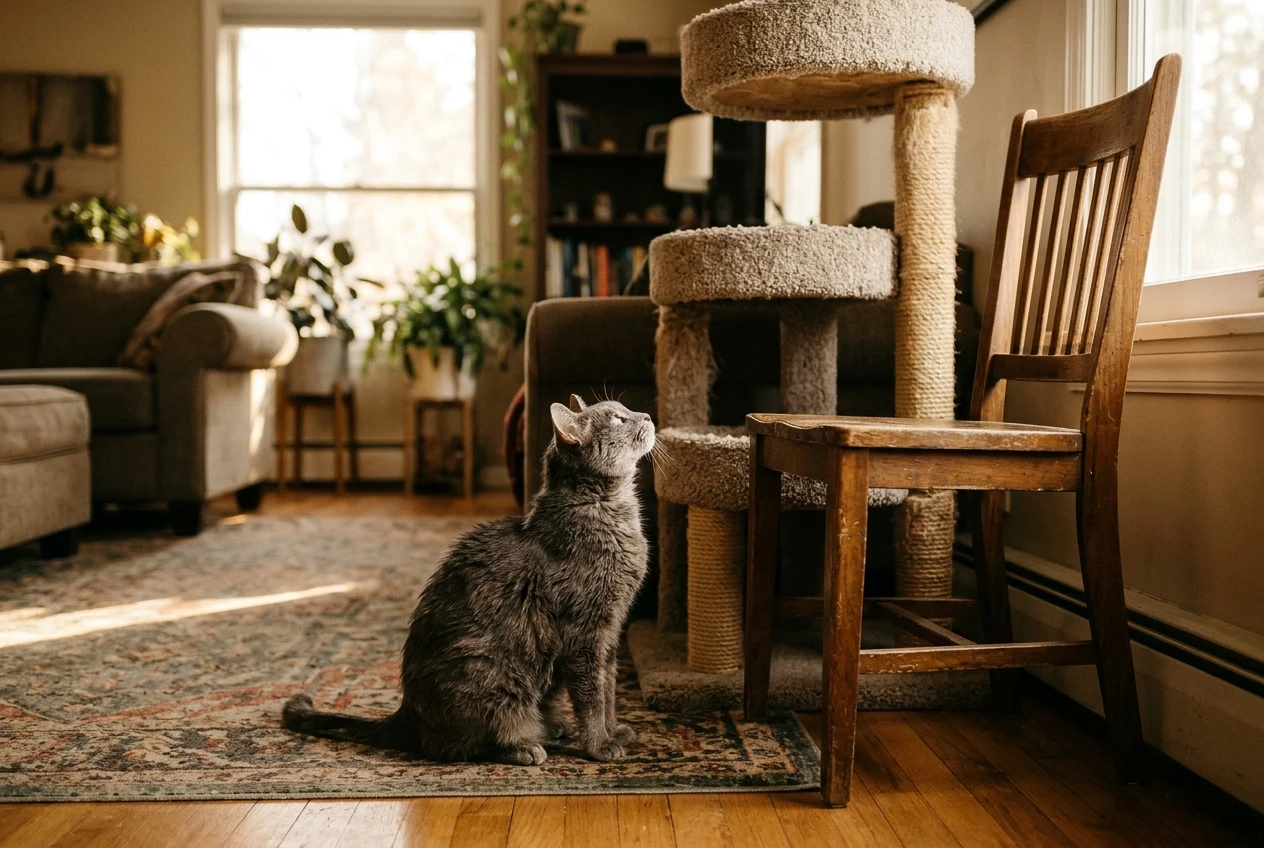
- Does your cat still jump to the places she used to love, or does she now take two steps via a chair first?
- Has she stopped using the top of the cat tree, the windowsill or your bed?
- Is she hesitating before jumping down, or landing heavily?
- Is she playing less, or only in short bursts?
- Is she grooming less, leaving a rough or greasy coat, or grooming one spot obsessively?
- Is she sleeping in a different place, perhaps lower, more hidden, or in a tight curled position?
Any one of these has other possible causes. A pattern, or a change that keeps going, is the point where a vet visit makes sense, whatever the birthday count says.
Pain you can’t see: arthritis, dental trouble and hidden illness like kidney disease
Some of the most common sources of pain give you almost nothing to look at.
Arthritis is the quiet one described above. Your cat looks normal standing still, and the evidence shows up in what she avoids.
Dental trouble is another. Mouth pain tends to show up around food: dropping kibble, chewing on one side, approaching the bowl eagerly and then walking away, drooling, or pawing at the mouth. A cat with a sore mouth may also stop wanting her face touched. Your vet can look at the teeth and gums properly, which you cannot do well at home.
Hidden illness matters too, and kidney disease is a well-known example in older cats. It often looks like increased thirst, more urine, weight loss or a dull coat, and it can sit alongside discomfort and nausea. Because it can be easy to dismiss as aging, it is worth reading what the evidence says about chronic kidney disease in cats if your cat is older or you have noticed changes in drinking or weight.
A 5-minute home check you can do on a lazy Sunday
Grab your phone, a treat, and a quiet room. Do this when your cat is relaxed and ideally awake.
Minute 1: Face. Look at your cat’s ears, eyes, muzzle, whiskers and head position, and compare them with your baseline photos. Take a fresh photo if anything looks different.
Minute 2: Posture. Watch how she sits and lies. A hunched, tucked position that lasts a long time, a head held low, or reluctance to stretch out can all be worth noting.
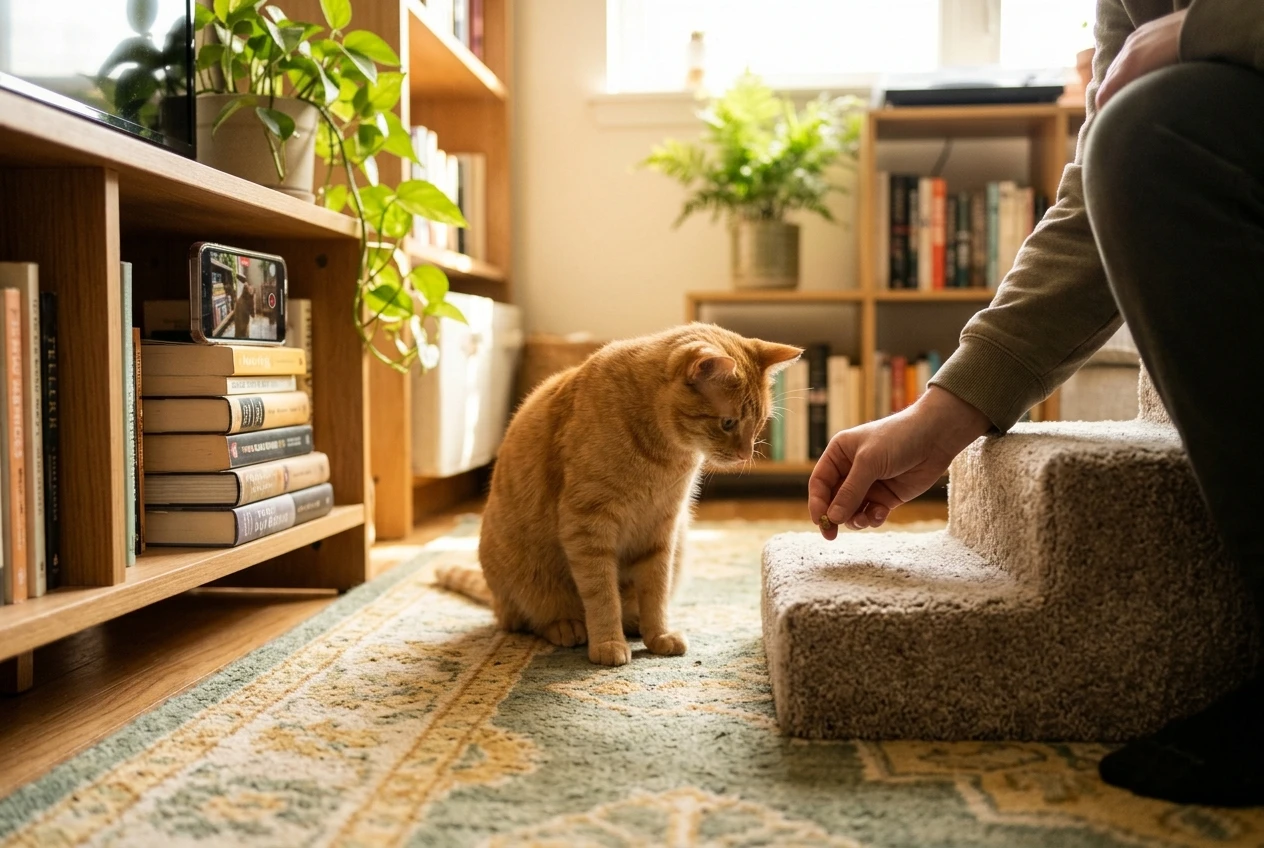
Minute 3: Movement. Toss a treat onto a low step, then a higher surface, or encourage a jump to her usual perch. Watch for hesitation, a pause before jumping, stiffness on landing, or a detour. Film it if you can, because a vet can learn a lot from a short video.
Minute 4: Hands-on, gently. Stroke from head to tail the way she likes. Notice any flinching, tensing, a quick look back at you, or twitching skin along the spine or hips. Stop if she objects. Pushing to find the sore spot is the vet’s job.
Minute 5: Routine check. Think through the litter box (is she stepping carefully over the edge, or going outside it?), the food bowl (eating normally, or dropping food?), grooming, play, and where she sleeps. Write down anything that is different from a month ago.
Keep the notes. A dated list with a couple of videos is far more useful to a vet than a general impression, and repeating the check every few weeks makes slow changes visible.
When to stop watching and call the vet
Watching is for small, uncertain changes. Some signs mean you should not wait.
Call the vet right away, or go to an emergency clinic, if your cat:
- Strains in the litter box and passes little or no urine, which can be a life-threatening emergency, particularly in male cats
- Breathes with an open mouth or looks like she is struggling to breathe
- Cries out, or reacts sharply when touched
- Suddenly cannot use her back legs, or collapses
- Vomits repeatedly or cannot keep anything down
- Refuses food altogether
Book an appointment soon if you notice:
- Any of the changes above (less jumping, hiding, grooming changes, litter box changes) that last more than a couple of days or keep getting worse
- A cat who is eating but dropping food or chewing oddly
- A new squint, a tight-looking face, or ears that stay flattened
- Weight loss or a big change in drinking
You do not need to prove your cat is in pain before you call. The point of the call is to find out. Describe what you noticed, share the notes and videos, and let the vet decide what it means.
One firm rule: never give a cat human painkillers. Common over-the-counter medicines such as acetaminophen and ibuprofen are toxic to cats. Pain relief for cats should come from a vet, who can also choose options suited to your cat’s age and health, as pain management guidelines for dogs and cats emphasize [7].
Small comfort tweaks that help once your vet is on board
#ad | Affiliate links below.
Once a vet has examined your cat and you have a plan, small changes at home can make daily life easier, especially for a cat with sore joints. These support the vet’s advice and do not stand in for it.
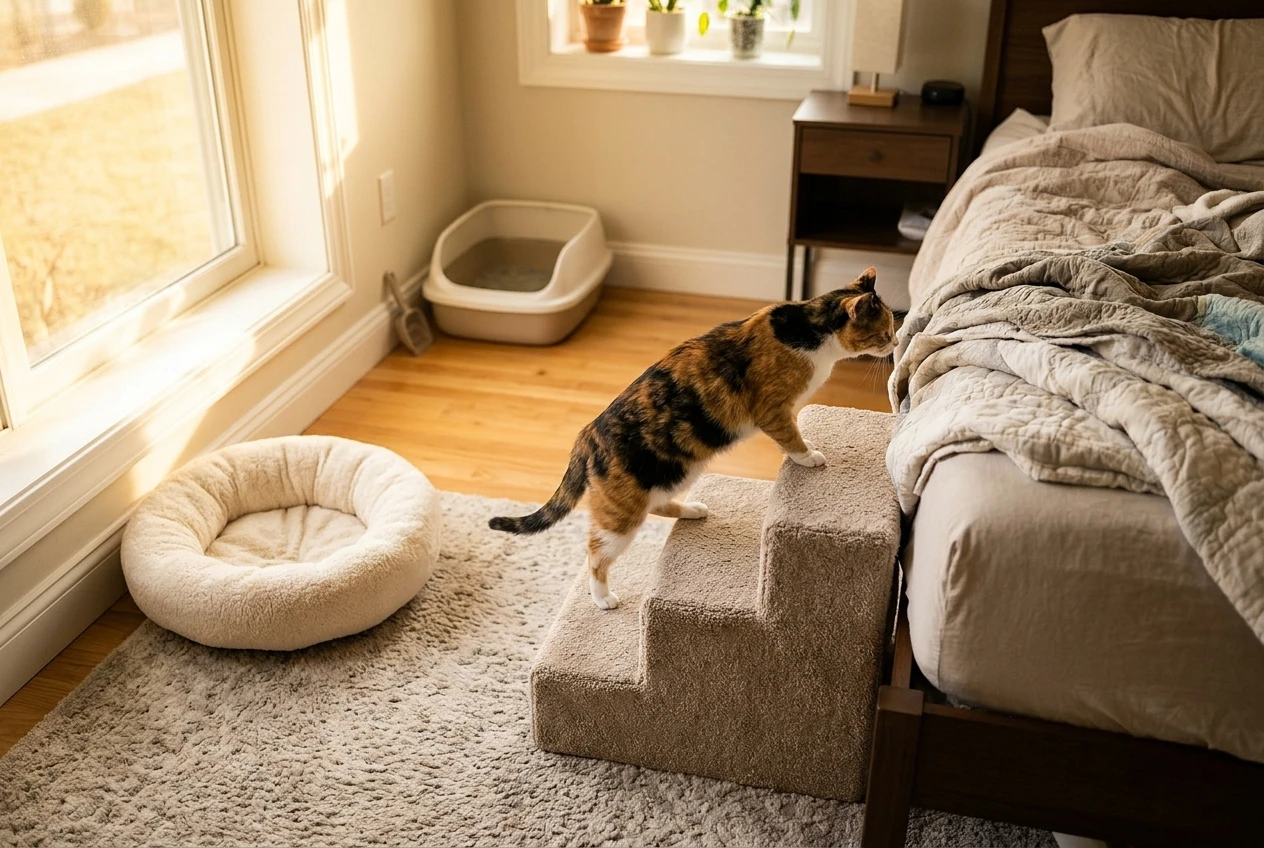
- Lower the entry. A litter box with a low front edge is easier to step into than a tall-sided one. Put it somewhere on the same floor your cat spends most of her time.
- Add steps. A pet step or ramp beside the bed, sofa or favorite window turns one big jump into two small ones.
- Bring comfort to her level. A soft, supportive bed in a warm, quiet spot gives sore joints a place to rest. Heat sources should be vet-approved.
- Keep essentials close. Food, water and the litter box should be within easy reach, without stairs in between. If space is tight, ideas in this guide to creating a cat corner for small spaces can help you fit everything in.
- Check the floors. Slippery surfaces are hard on stiff legs, so a rug or mat near her favorite spots can give her better footing.
Your weekend plan
#ad | Affiliate links below.
This weekend, set aside five minutes, take your baseline photos, and run the home check. If anything stands out, whether it is a face that looks tense, a jump that has become a climb, or a litter box habit that has changed, book a vet visit and bring your notes. Catching pain early is far easier than catching it late.
If your vet has confirmed a plan and you are looking at ways to make home more comfortable, a few low-entry litter boxes, pet steps and cozy beds are a gentle place to start. Browse the low-entry litter boxes, pet steps and cozy cat beds we have picked out on Amazon, and treat them as support after a vet visit, never as a replacement for one. If you buy through these links, this site may earn a small commission at no extra cost to you.
References
- Evangelista MC, Watanabe R, Leung VSY, et al. Facial expressions of pain in cats: the development and validation of a Feline Grimace Scale. Scientific Reports. 2019;9:19128. View source
- Merola I, Mills DS. Systematic review of the behavioural assessment of pain in cats. Journal of Feline Medicine and Surgery. 2016;18(2):60-76. View source
- Benito J, Depuy V, Hardie E, et al. Reliability and discriminatory testing of a client-based metrology instrument, feline musculoskeletal pain index (FMPI) for the evaluation of degenerative joint disease-associated pain in cats. The Veterinary Journal. 2013;196(3):368-373. View source
- Lascelles BDX, Henry JB, Brown J, et al. Cross-sectional study of the prevalence of radiographic degenerative joint disease in domesticated cats. Veterinary Surgery. 2010;39(5):535-544. View source
- Robertson SA, Lascelles BDX. Long-term pain in cats: how much do we know about this important welfare issue? Journal of Small Animal Practice. 2010;51(10):537-541. View source
- Bennett D, Zainal Ariffin SMZ, Johnston P. Osteoarthritis in the cat: 1. How common is it and how easy to recognise? Journal of Feline Medicine and Surgery. 2012;14(2):65-75. View source
- Epstein ME, Rodan I, Griffenhagen G, et al. 2015 AAHA/AAFP pain management guidelines for dogs and cats. Journal of Feline Medicine and Surgery. 2015;17(3):251-272. View source