
Good senior cat care comes down to three habits: a short weekly check at home, a vet visit at least every six months, and comfort upgrades that make stairs, litter boxes and beds easier on stiff joints. Write down what you notice each week so small changes are monitored early [1].
🐾 Purr-lease Note: As an Amazon Associate I earn from qualifying purchases. This means FelineGo may earn a small commission when you purchase through some of the Amazon links on this site, at no extra cost to you. These commissions help support FelineGo and our mission to create helpful content for cat parents. Thank you for supporting our little corner of the cat world! 🐱💕
When is a cat officially a senior, and what changes first?
A cat is generally considered a senior from about 11 years old, and the mature stage of 7 to 10 years is when the first changes tend to start [1]. Cats age at different speeds, so the number on the birthday card matters less than what you see on the couch.
The first changes are quiet ones. Your cat may sleep a little more, skip the leap onto the kitchen counter, groom less thoroughly along the back, or take a beat before climbing the stairs. Some cats get chattier at night. Others get pickier about food.
Each of these has a harmless explanation and a medical one, and you cannot tell which from across the room. That is why this routine is built around noticing and recording rather than diagnosing. Your vet does the diagnosing, and your notes make that job faster.
What should you check on your senior cat every week?
#ad | Affiliate links below.
Pick one calm moment each week, ideally when your cat is relaxed and in a good mood, and run through the same short checklist. Ten minutes is plenty, and treats help a lot.
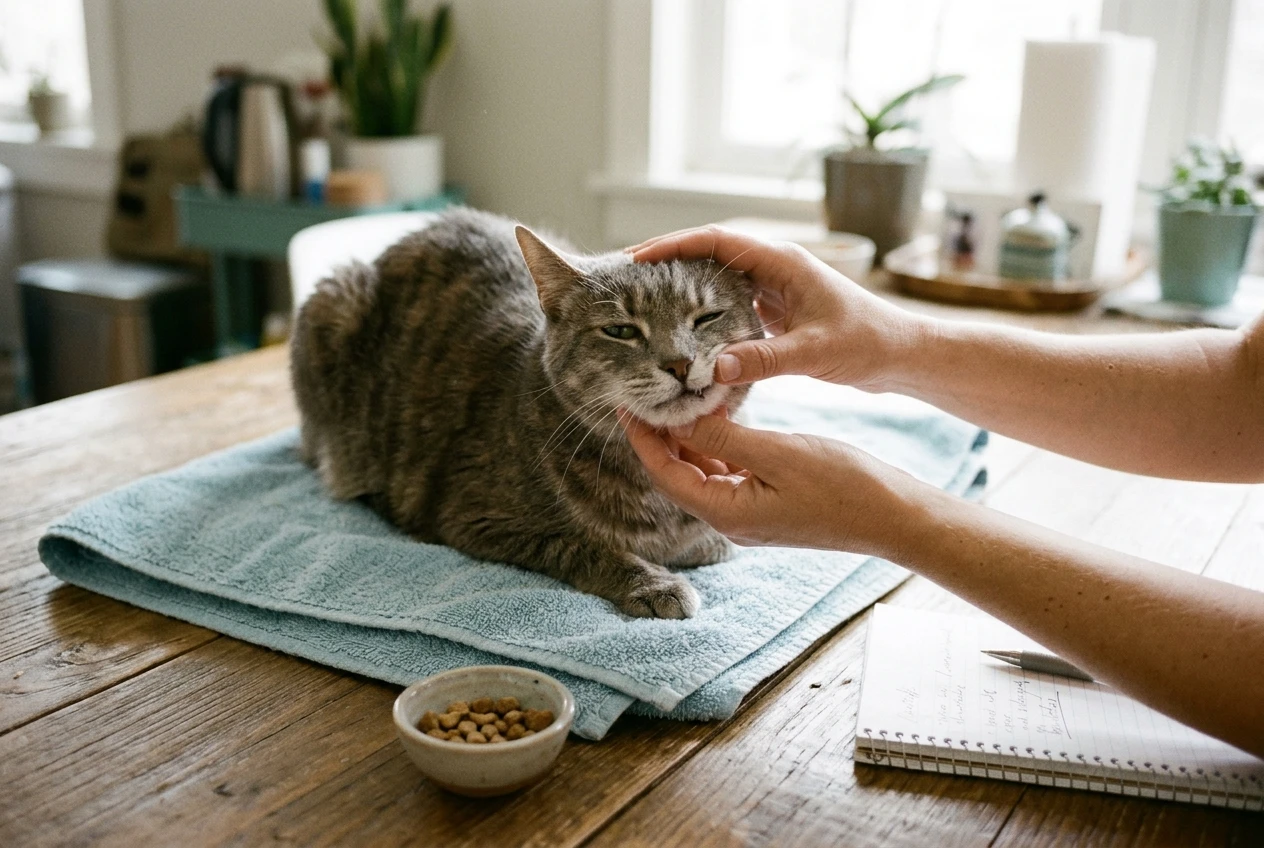
- Weight. Weigh your cat on a baby scale or by weighing yourself holding the cat and then alone. Gradual, unexplained weight loss is one of the most important things to report to your vet [1].
- Body feel. Run your hands along the spine, ribs and hips. Note any new lumps, or spine and hip bones that feel more prominent than last month.
- Coat and skin. Look for mats, dandruff, greasy patches or a coat that has turned dull.
- Eyes, nose and ears. Check for discharge, cloudiness, squinting, or one pupil that looks different from the other.
- Mouth. Lift the lip gently. Look for red gums, brown tartar, and notice any strong breath.
- Nails. Older cats scratch less, and their nails can grow long and thick. Trim any that are curling toward the paw pad.
- Litter box. Note how many clumps there are, whether the size has changed, and whether any accidents happened outside the box.
- Appetite and water. Compare how much your cat eats and drinks to the week before.
- Movement. Watch your cat jump onto a favorite perch and come back down.
Keep the notes in a phone note or a paper notebook, with the date and one line per item. A single odd week means little. Three weeks in a row of the same change is something to bring to your vet.
How often does a senior cat need the vet?
#ad | Affiliate links below.
Senior cats should see the vet at least every six months, which is twice as often as a healthy younger adult [1]. Problems in older cats can progress in months, so a yearly visit leaves too long a gap.
Life stage: Young adult
Typical age: 1 to 6 years
Vet visit rhythm: At least yearly
Life stage: Mature adult
Typical age: 7 to 10 years
Vet visit rhythm: At least yearly
Life stage: Senior
Typical age: 11 years and up
Vet visit rhythm: At least every 6 months
A senior wellness visit usually includes a full physical exam, a weight and body condition check, and often bloodwork and a urine test. Your vet may also check blood pressure. Exactly which tests are right for your cat is a decision for your vet, based on age and history.
Bring your weekly notes. “She seems a bit off” is hard to act on. “She lost weight over six weeks, drinks more, and has skipped the top stair twice” gives your vet something to work with.
Many cats hate the carrier more than the vet. Leave the carrier out in the house with a blanket inside, so it becomes a napping spot instead of a signal.
Is your senior cat in pain? What to watch for (and where to read more)
Cats hide discomfort well, so pain in older cats usually shows up as a change in behavior rather than crying or limping. Joint pain from osteoarthritis is common: one radiograph study found degenerative joint disease in the majority of older cats [3].
Watch for these signs:
- Hesitating before jumps, or stopping short of the usual perch
- Grooming less, or matted fur on the back and hips
- Hiding more, or avoiding being picked up
- Peeing or pooping just outside the litter box, often because climbing in hurts
- Irritability when touched in a spot that used to be fine
- A tense, squinty face; researchers developed a Feline Grimace Scale that scores ear position, eye narrowing, muzzle tension and whisker position to help spot pain [2]
None of these means pain for certain, but all of them deserve a note in your log and a mention to your vet. Pain in cats can be treated, and cats often get more active once it is controlled.
For a deeper look at what the research says about why cats conceal discomfort, read Why Cats Hide Pain: What Feline Pain Research Tells Owners to Watch For. Never give your cat human pain medication. Several common ones are toxic to cats.
How should you feed an older cat?
#ad | Affiliate links below.
Feed an older cat the amount and type of food that keeps a healthy weight and good muscle, and let your vet set the details. Body condition and muscle condition scoring are standard parts of senior exams for this reason [1].
Older cats can go in either direction. Some lose weight and muscle, and others gain it as they slow down. Your weekly weigh-in tells you which way yours is heading.
Small changes to how you serve food can help a lot:
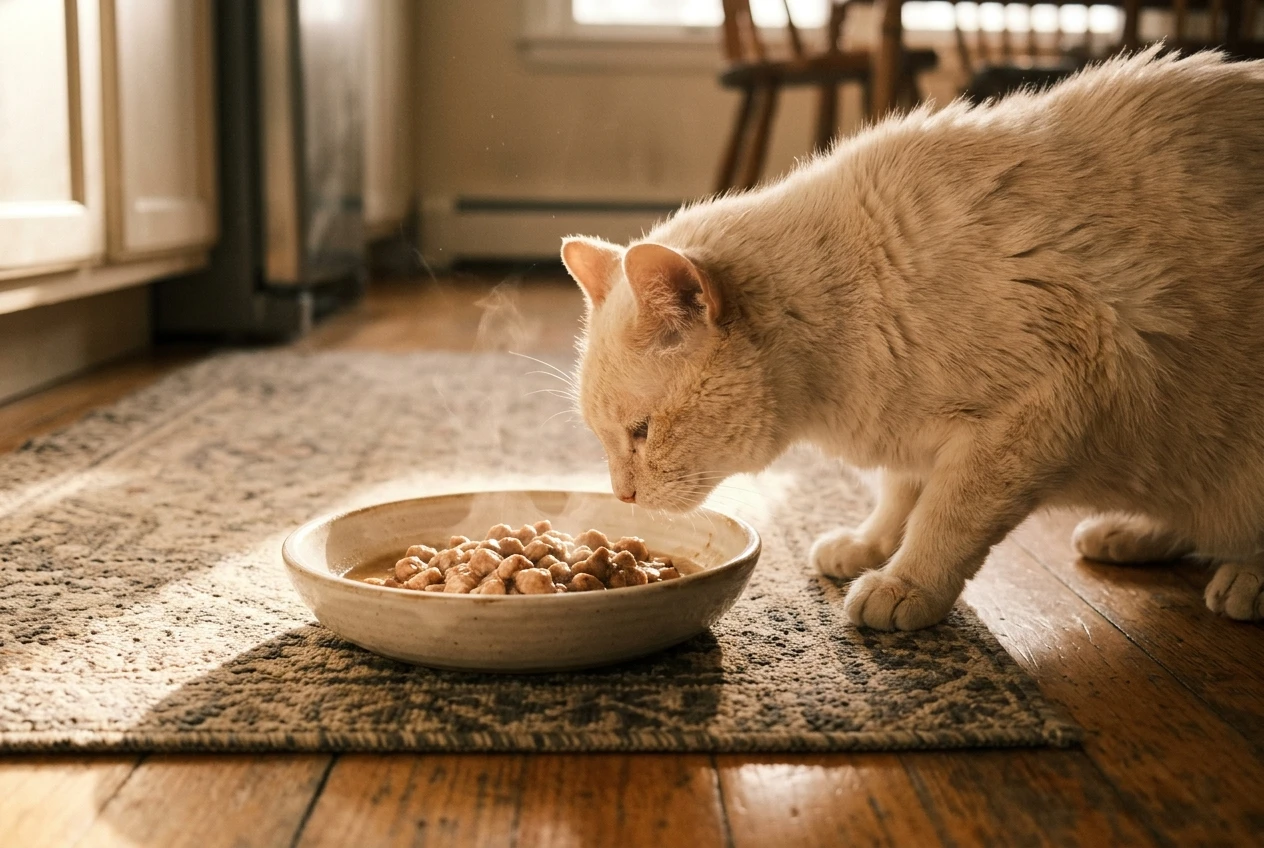
- Offer several smaller meals instead of one or two big ones.
- Warm wet food briefly to bring out the smell, which helps cats with a weaker sense of smell.
- Use shallow, wide bowls if your cat seems to dislike deep dishes.
- Put a bowl on every floor your cat uses, so a trip downstairs is not required for dinner.
- Keep fresh water in more than one spot, and consider a fountain if your cat likes running water.
Do not switch to a “senior” or prescription diet on your own because of a label. Diet needs differ a lot between a healthy 12-year-old and a cat with kidney or thyroid disease. Ask your vet which food fits your cat, then make any change gradually over about a week.
What about teeth and kidneys in older cats?
Teeth and kidneys are the two areas to watch most closely, because trouble in either can build for a long time before it is obvious. Your weekly mouth check and your litter box and water notes are how you keep an eye on both.
Teeth. Red gums, drooling, dropping food, chewing on one side, or bad breath are all worth reporting. Dental disease is common in older cats and is painful, and a cat in mouth pain may still eat because it is hungry. Our article Does Dental Disease Shorten a Cat’s Life? What Veterinary Studies Show covers the evidence in detail. Professional cleaning and dental X-rays happen at the vet, so do not try to scrape tartar off at home.
Kidneys. Chronic kidney disease is one of the more common conditions of older cats, and early signs include drinking and urinating more, weight loss and a poorer coat [1]. Your litter box notes catch the first of these. Larger clumps or a heavier box than usual is the pattern to mention. If your vet diagnoses kidney disease, diet becomes a major part of managing it, and Chronic Kidney Disease in Cats: What the Evidence Says walks through that research.
Which comfort upgrades actually help a stiff, older cat?
#ad | Affiliate links below.
The upgrades that help most are the ones that remove a jump, a climb or a slippery floor from your cat’s day. Start with wherever your cat has already stopped going, because that tells you where it hurts.
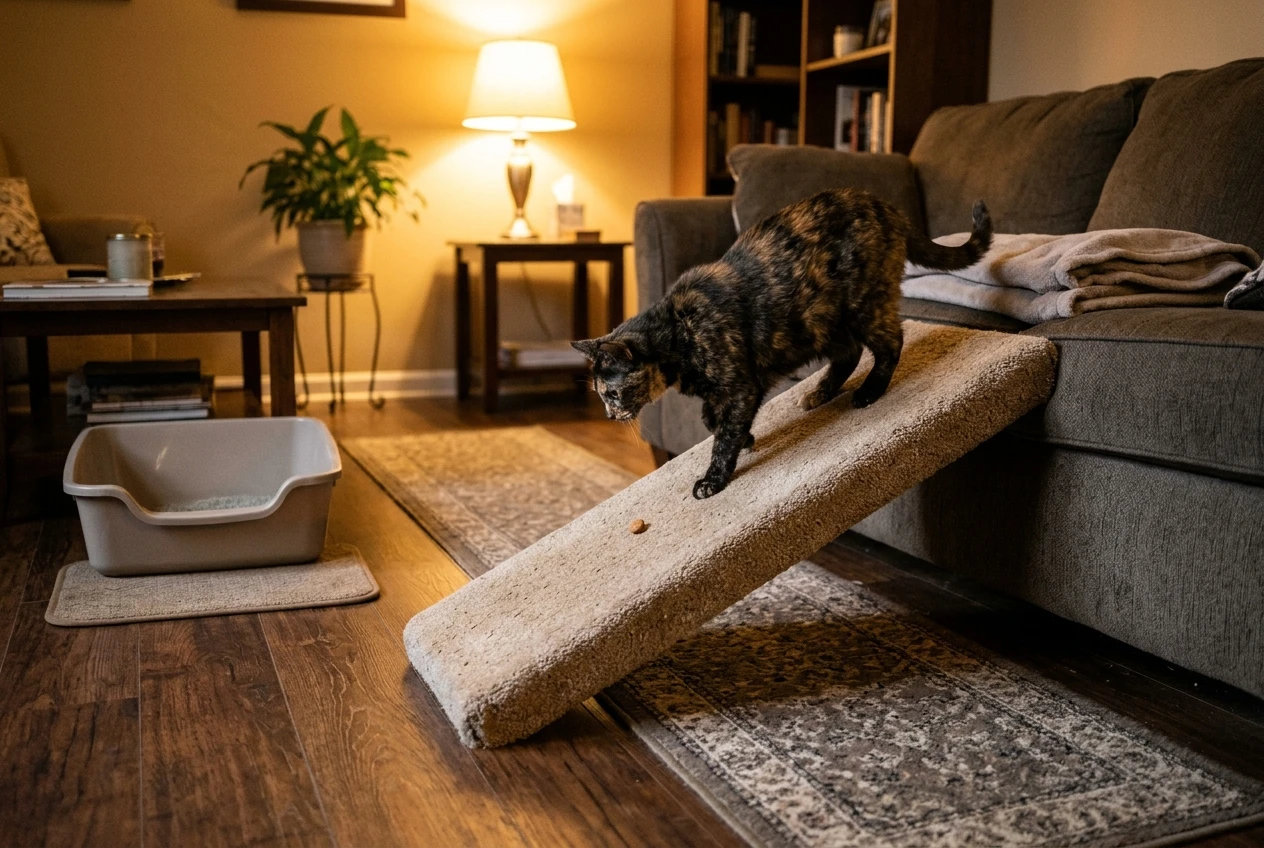
Where your cat struggles: Reaching the couch or bed
Upgrade to try: Ramp or pet steps
What to look for: Wide, stable, with a grippy surface that does not slide
Where your cat struggles: Getting into the litter box
Upgrade to try: Low-entry litter box
What to look for: A low front edge and enough room to turn around
Where your cat struggles: Slippery hard floors
Upgrade to try: Non-slip mats or runners
What to look for: Mats placed on the route between bed, food and box
Where your cat struggles: Staying warm
Upgrade to try: Soft bed, or a heated pad made for pets
What to look for: A low entry, and a heated pad with a chew-resistant cord and a pet-safe design
Where your cat struggles: Eating and drinking
Upgrade to try: Shallow dishes or a slightly raised bowl
What to look for: Stable base, easy to wash
Where your cat struggles: Grooming
Upgrade to try: Soft brush
What to look for: Gentle bristles, since older skin is more sensitive
Placement matters as much as the product. Put a ramp where your cat already jumps. Put a litter box on every floor your cat uses, and keep one away from noisy appliances. A night light along the route to the box helps cats with dimmer vision.
Introduce one change at a time. Leave a treat on the ramp, toss a toy up the steps, and let your cat decide when to use it.
How do you keep an older cat’s mind busy?
#ad | Affiliate links below.
Short, easy, regular play keeps an older cat’s mind active and gives you a daily look at how well they move. Aim for a few brief sessions instead of one long one, and stop before your cat gets tired.
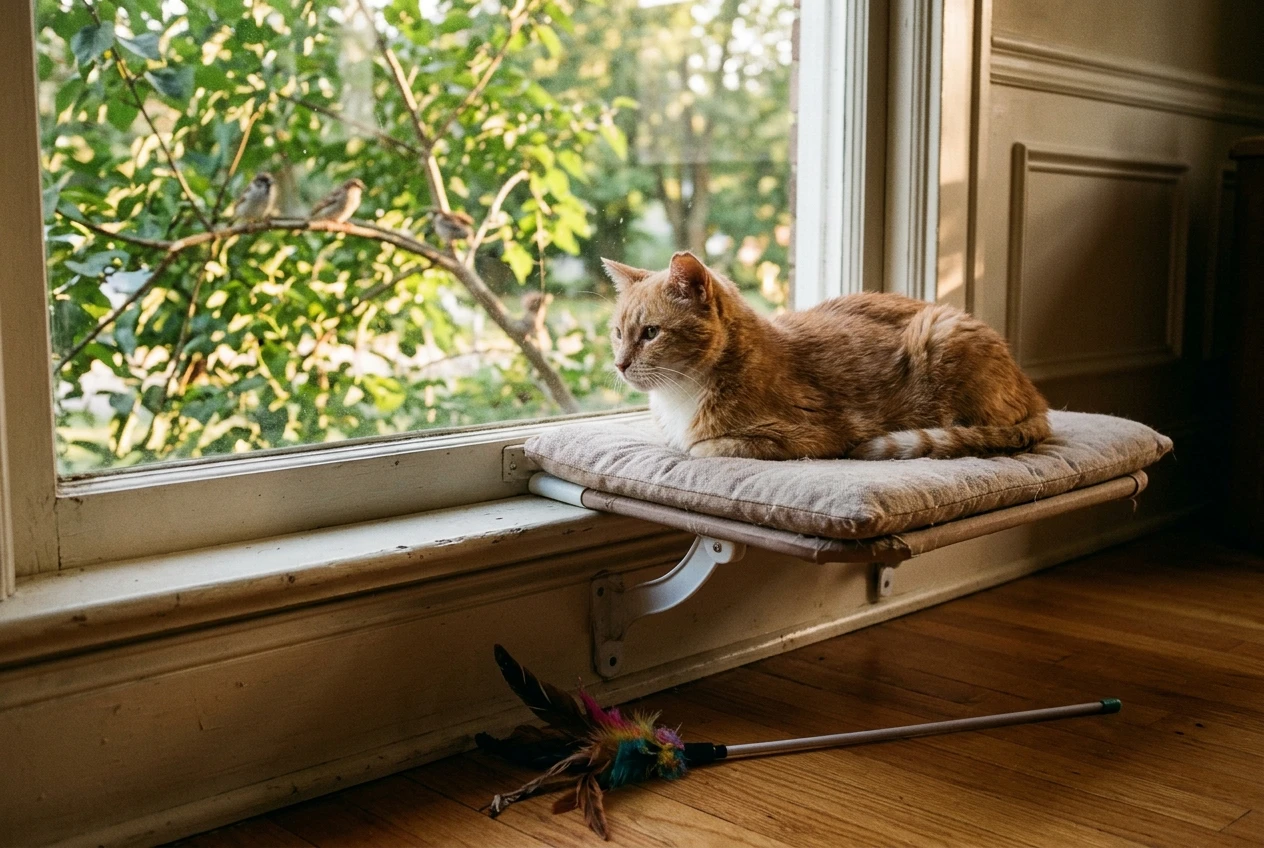
Some options that suit slower cats:
- A window perch. Birds and passing neighbors are free entertainment, and a perch at the right height saves a jump.
- Easy food puzzles. Start with a puzzle that hands out treats quickly, and make it harder only if your cat enjoys it.
- Gentle wand play. Drag the toy along the floor so your cat can bat at it without leaping.
- Scent games. Hide a few treats around a room for your cat to sniff out.
- A steady routine. Feeding, play and brushing at similar times each day helps cats who have become more anxious.
Watch how your cat plays as well as whether they do. A cat who used to pounce and now only watches is giving you information for your weekly log. For more toy ideas, see Cat Enrichment Toys to Keep Your Cat Busy While You Read.
Your plan for this weekend
#ad | Affiliate links below.
Pick one comfort upgrade from the gear section to try this week, such as a ramp or a low-entry litter box, and book a senior wellness check with your vet. Take your weekly home notes with you.
References
- Quimby J, Gowland S, Carney HC, DePorter T, Plummer P, Westropp J. 2021 AAHA/AAFP Feline Life Stage Guidelines. Journal of Feline Medicine and Surgery. 2021;23(3):211-233. View source
- Evangelista MC, Watanabe R, Leung VSY, et al. Facial expressions of pain in cats: the development and validation of a Feline Grimace Scale. Scientific Reports. 2019;9:19128. View source
- Lascelles BDX, Henry JB, Brown J, et al. Cross-sectional study of the prevalence of radiographic degenerative joint disease in domesticated cats. Veterinary Surgery. 2010;39(5):535-544. View source